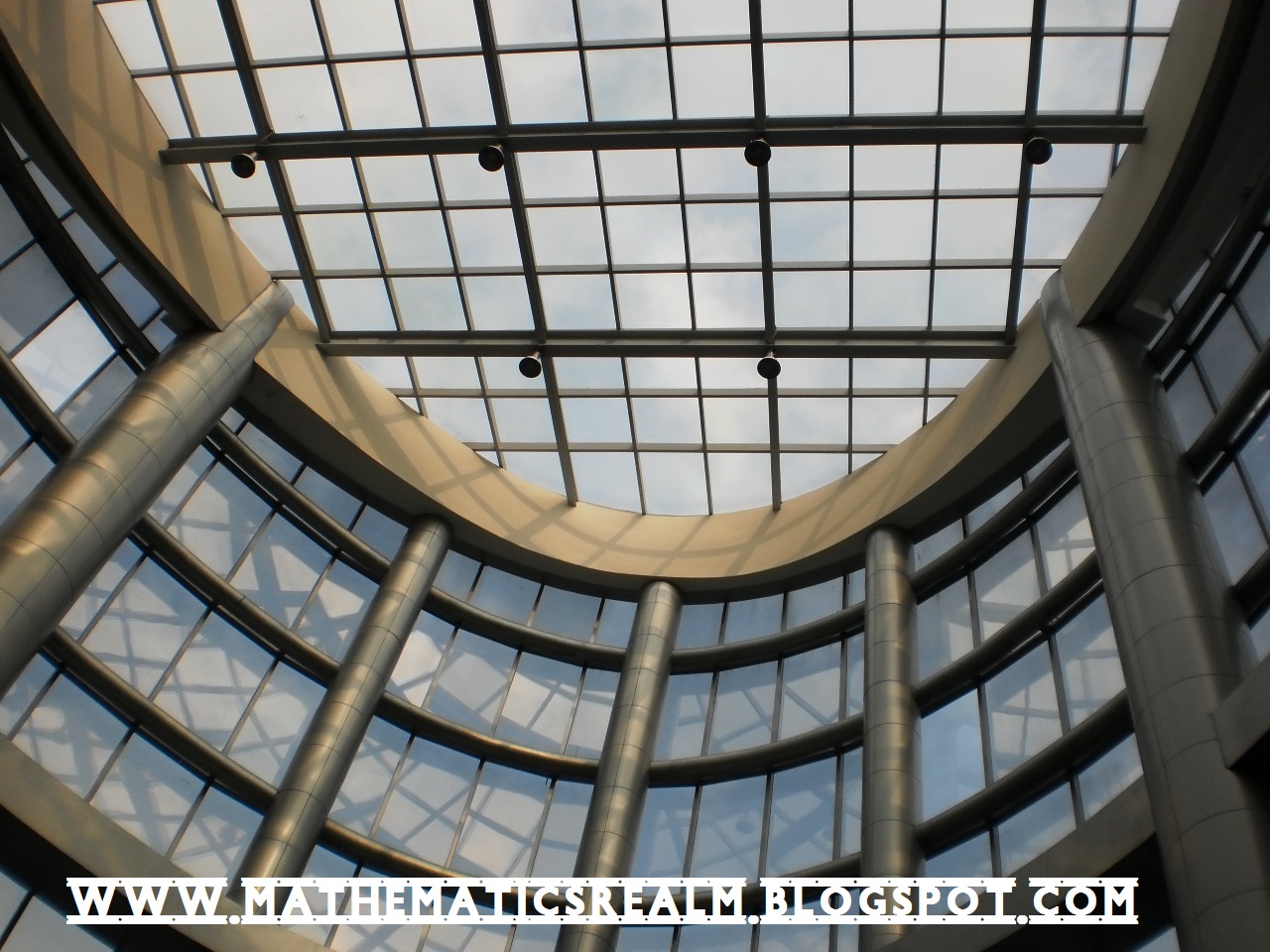
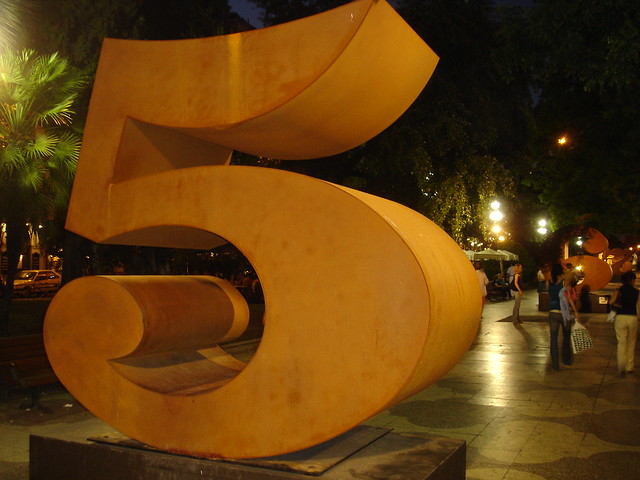
THE BEAUTY OF MATHEMATICS 5

Another photo depicting the use of mathematics in architecture.

12-POINT PUZZLE

Your goal is to connect the dots using 5 straight lines only.

HAPPY HOLIDAYS

A holiday greetings from REALM OF MATHEMATICS

THE BEAUTY OF MATHEMATICS 4

This is the fourth photo depicting the beauty and use of mathematics on famous places.

THE BEAUTY OF MATHEMATICS 3

This is the third photo depicting the beauty and use of mathematics on famous places.

THE BEAUTY OF MATHEMATICS 2

This is the second photo depicting the beauty of mathematics in our surroundings.

THE BEAUTY OF MATHEMATICS 1

This is the first of the series of photos appreciating math in the world.

THE MATHEMATICS OF LIFE

This is the reality of life.

HAPPY 40th ANNIVERSARY RUBIKS CUBE

This day is the 40th anniversary of the Rubik's cube, which was first introduced in Hungary.

LEARN AT MATHEMATICS REALM

This is the extension of the mathematics realm blog. It contains math lessons, tutorials, downloads, etc.

SYMMETRY AND TRANSFORMATION

A work of art depicting symmetry and transformation.

HAPPY HOLIDAYS 2013!

A greetings from Realm of Mathematics and Learn at Mathematics Realm!

BLOG ACTION DAY 2013

I have already registered. COme and join us!

MATH ARTS 4

Another figure being formed by transformation.

MATH QUOTES 1

A very famous quotation about math.

MULTIPLES OF 9 PATTERN

A very simple pattern found on the multiples of 9.

MATH ARTS 3

Another figure being formed from symmetrically rotated and transformed picture of a famous mall in Jakarta.

NUMBER PUZZLE 2

A very simple number puzzle you would definitely like. One is explained well and the other is given for you to try. Good luck!

MATH ARTS 2

This images are created from a symmetrically rotated and transformed picture.

MATH ARTS 1

This is a simple art created by using circles of different sizes and colors.

NUMBER PUZZLE

This is a simple puzzle involving a pattern of numbers. Try to decipher the pattern and find the missing numbers.

BIG NUMBER PUZZLE

This is a simple puzzle of creating the largest possible number using the indicated numbers and symbols

CUBE COUNTING 2

This is the second part of the cube counting series. Just count the number of cubes being used in the figure.

LEARN AT MATHEMATICS REALM

This is an extension of the mathematics realm blog. It provides information, lessons and tutorials on specific topics from different areas of mathematics.

HOLY WEEK 2013

A simple mathematical statement that means a lot.

BIBLICAL NUMBERS

This are the first ten biblical numbers. What do they represent?

CONNECTING DOTS WITH LINES

This is one of the most common math puzzles. It involves connecting dots using a specified number of lines and following some conditions

A MAN IS LIKE A FRACTION

A math quotation to think about.

TRIANGLE COUNT

A simple problem that tests your patience and accuracy in counting.

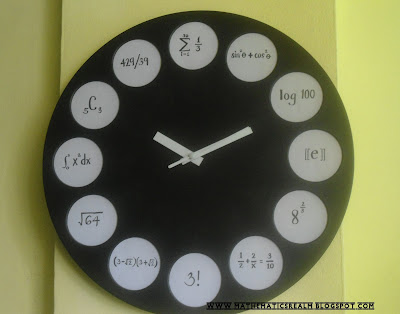
MATH CLOCK

A clock showing different expressions from different areas of mathematics

MULTIPLYING NUMBERS BY 5

A technique in getting the product of any number and 5

CURVES FORMED FROM STRAIGHT LINES

These are curves approximated by the series of straight lines. You can test your creativity by forming a mathematical artwork using the curves.

HOW TO DIVIDE A SQUARE INTO FOUR EQUAL PARTS

These are some of the ways on how to get four equal parts in a square.

CUBE COUNTING

Count the number of smaller cubes in each figure.

SQUARING NUMBERS NEAR 100 (Case 2)
Second part of two cases. This is the easiest way to square a number near and greater than 100.

SQUARING NUMBERS NEAR 100 (Case 1)

First part of two cases. This is the easiest way to square a number near and less than 100.

MULTIPLYING NUMBERS BY USING LINES

The easiest way of multiplying numbers using parallel and intersecting lines.

THE COIN TRIANGLE PROBLEM

Rearrange the coin in a reversed triangular form.

THE VALUE OF MONEY

The value and limitations of money.

EARTH HOUR 2012!

This is to promote for the Earth Hour 2012 on March 31, 2012. Read more for details...

MATHEMATICAL WAY OF SAYING I LOVE YOU!

A math inequality problem leading to the word i love you!.

THE MISSING COIN PROBLEM

A problem about the missing coin used in daily activities.

THE 3 CATS, 3 MICE PROBLEM

A puzzle is about cats catching mice in a day.

DIGITAL CIRCLISM

See the beauty and use of circles in different artworks. Can you guess who are in the images?

THE SIGNIFICANCE OF 40 DAYS IN THE BIBLE

This is the list of significant events in the Bible that have been done in 40 days.

BASIC MATH QUIZ PART I (Decimals and Integers)

This will test your knowledge about basic concepts in mathematics, specifically on decimals and integers.

Year 2011

Notable dates that makes year 2011 amazing and special.

MATH TALK

A simple conversation of a couple integrating math in the talk.

MULTIPLYING NUMBERS BY 11

This is the fastest and easiest way to multiply numbers by 11.

SQUARING NUMBERS ENDING IN 5

This is the easiest way to square a number ending in 5.You can actually do this in seconds only!

PARALLEL LINES

Comparison between the definition of parallel lines in Euclidean Geometry and in Non-Euclidean Geometry.

MAZES

Aside from the usual form of mazes that we know, there are mazes that are computer generated, which also resemble some common objects or people.

DAYS OF THE MONTHS

This uses body parts to easily remember the exact number of days for every month of the year.

HOW FAR IS A STORM FROM YOU

A basic computation that can easily determine the distance of a storm from your location.

THE BIBLE CODE PUZZLE

A mathematical connection on the words that can be found in the Bible.

March 17, 2013

BIBLICAL NUMBERS

mathematics,IGCSE,patterns,symmetry,transformation,geometry,polygons


mathematics,IGCSE,patterns,symmetry,transformation,geometry,polygonsOne

The number one is for God. 


We must begin with number one or we cannot have number two or any other number. 

mathematics,IGCSE,patterns,symmetry,transformation,geometry,polygonsMathematically speaking we cannot get anywhere without the number one. We must begin with God.

Two

The number two is for man. Man as an individual. 


mathematics,IGCSE,patterns,symmetry,transformation,geometry,polygonsGod made man and Christ is “called the second man.”


Three


Three is the number for the Trinity. God is a triune God; 

Father, Son and Spirit. 

The atmosphere, which we live in, is a trinity of oxygen, hydrogen and nitrogen. 

The tabernacle was a trinity with its court, holy place, and Holiest of Holies.

The first chapter of Revelation is full of trinities of Truth.
V. 2 – The Word of God, The testimony of Jesus, All things that He saw.
V. 3 – Read, Hear and Keep.
V. 4 – Which is, Which was, and Which is to come.
V. 5 – The Faithful Witness, The First begotten of the dead, The Prince of the kings of the earth.
V.5, 6 – Loved us, Washed us, Made us kings and priests.
V. 7 – Every eye shall see him, They also which pierced him, All kindreds of the earth.
V. 9 – Tribulation, Kingdom, Patience
V. 18 – I am He that liveth, Was dead, Alive for evermore.
V. 19 – Things seen (Past), Things which are (Present), Things which shall be (Future).

Who would dare to contradict the trinity as these Ten appear in one chapter alone, chapter one of Revelation. Certainly no Spirit filled believer or student of scripture would not affirm its validity.


mathematics,IGCSE,patterns,symmetry,transformation,geometry,polygons
Four

Four is the number of humanity as a whole. There were four men in the Ark, four men in the fiery furnace, four on the mount of Transfiguration. The four points of the compass comprise the whole of humanity in all the earth.


mathematics,IGCSE,patterns,symmetry,transformation,geometry,polygons
Five

Five is the number for grace – grace accepted or grace rejected. 

There are five wise and foolish virgins.


mathematics,IGCSE,patterns,symmetry,transformation,geometry,polygons
Six

The number six is the number for evil.

A man with six toes and six fingers is called a wicked man in the Bible. 

Nebuchadnezzra’s image was sixty feet high and six feet in circumference and six musical instruments called the people to worship. 

The number for the Anti-Christ is six hundred sixty-six. This is set forth the trinity of evil, the climax of wickedness, and the culmination of iniquity. There can not be anything worse than 666.

mathematics,IGCSE,patterns,symmetry,transformation,geometry,polygonsSeven

Seven is the number for perfection. This number is frequently mentioned in scripture: seven churches, seven stars, seven heads, seven horns, seven eyes, seven Spirits of god, the seven branches of the candlestick.

In Judges, the seventh book of the Bible, there are seven departures from God; seven times the people repented and seven times Jehovah delivered his people from their enemies.


mathematics,IGCSE,patterns,symmetry,transformation,geometry,polygons
Eight

Eight is the number for that which is New. There are eight beatitudes which set forth something entirely new. Everything good in this sinful world owes its presence and existence to the Word of God. The resurrection of Christ and of many of the saints took place on the eighth day. Here indeed and in truth was something new.

mathematics,IGCSE,patterns,symmetry,transformation,geometry,polygons

Nine

Nine is the number of finality. Since it is the last digit, it marks the end. It may laso mean judgment. 


mathematics,IGCSE,patterns,symmetry,transformation,geometry,polygons
Ten

Ten is the number of completeness. Jacob’s wages were changed ten times, which sets forth complete disappointment outside the will of God and his Promised Land. 

Eliezer, the servant, took ten camels with him when he started from home in order to obtain a bride for Isaac. God gave his people Ten Commandments. 

Daniel and his three friends were proved ten days and at the end of the test were ten times better than the others. Christ gave the parable of the ten pounds and ten talents. Christ healed ten lepers. The dragon of Daniel and Revelation had ten horns, which represent ten kings. The tenth or the tithe is the Lord’s...Shalom!


_______________________________________________________________
This article is taken from Pastor Nestor Miguel. I have read this in his posts and I would like to share it to everybody. 

Pastor Nestor Miguel is a Filipino pastor who is now at Bronx, New York. 

Thank you pastor!

March 3, 2013

CONNECTING DOTS WITH LINES


This is one of the most common math puzzles. It deals with 9 dots. Your goal is to connect all the dots using four (4) lines only without lifting your pen and without retracing.

Some of you might try to connect all the points forming a square, like in the figure below, but one of the dots is not connected.

Some might connect the dots like the figures below, but five (5) lines were used instead of four (4) lines only.


Some might connect all the points like the figure below. Four lines were used but the lines are not connected. Though they are connected at the middle, the lines might be drawn with retracing or lifting the pen used.

There are still a lot of possible ways others may try but some may violate the condition specified.

Actually, there are four (4) possible solutions for this puzzles, depending on which point you will start with. I will just show one of the solutions and you do the rest. Just simply change the starting dot. You would notice that the figures will look the same but differ in direction.

As you notice, the lines are extended but it does not violate any of the conditions specified in the puzzle.

Now I'll leave you a puzzle similar to this puzzle. Here are twelve (12) dots. Your goal is to connect all of them by using five (5) lines only without lifting your pens, without retracing, and forming a closed path - the last segment must stop at where the first segment started.


Good luck!  
 

February 23, 2013

A MAN IS LIKE A FRACTION


This is one of my favorite Math quotations. It is a reminder for me to evaluate myself as a teacher, as a student, as a person and as a son of God.

We should take note that in a fraction, as the denominator becomes larger, the value of the fraction becomes lesser. That is 1 > 1/2 > 1/3 > 1/4 > 1/5 > 1/6 > ....

Let us not be a person who sees himself/herself larger than who he/she really is. We might not get respect from other people.

Think about it...


October 5, 2012

TRIANGLE COUNT

Here is a very classic math puzzle/problem. Just simply count the number of triangles in each figure. However, many still find it confusing since you have to count all the smallest triangles, all bigger triangles, until the largest triangle. What is confusing in this part is that some triangles may be inside another triangle (e.g. 4 small triangles are inside the bigger triangle). 

This problem requires patience, time and accuracy in counting the triangles. Here are the figures. Count the triangles well. Good luck!
Figure 1

Figure 2

Figure 3

Do you think you correctly counted all the triangles in the figure?
Let me see how good are you at counting! Leave comments here for your answer in each figure.  

September 24, 2012

MATH CLOCK


This is my math clock. Use it everyday...

It could remind you of the abundance of mathematics around us - that the world is full of mathematics. A reminder that mathematics can be used by anyone, anywhere and anytime. A reminder that mathematics is important. A reminder that mathematics is necessary and sufficient!

Try to solve each of the mathematical expressions! Good luck!

July 12, 2012

MULTIPLYING A NUMBER BY 5


There are a lot of shortcuts and techniques in multiplying numbers, you just have to choose what is easy for you. This time, let us try to multiply numbers by 5. 

If a number is multiplied by 5, you could divide the number by 2 then multiply it by 10. This is easier because when a number is multiplied by 10, just simply append zero(0) to the number. This technique is very effective if the number being multiplied by 5 is divisible by 2.

The reason behind this technique is that 5 is the result when 10 is divided by 2 or 10/2 = 5. It means that if you multiply a number by 5, you can multiply it first by 10 then divide it by 2 or you can divide it by two then multiply by 10. The latter is easier. 

Let us use it in the following examples:


      The first thing to do is divide the number by 2. That is
      After that, multiply the result by 10 or simply append zero (0) on the result. That is
      Therefore, 


      Divide 186 by 2. 

     Multiply the result by 10.
    Therefore,

Now try these:
1. (56)(5)
2. (102)(5)
3. (258)(5)
4. (364)(5)
5. (273)(5)

July 4, 2012

CURVES FORMED FROM STRAIGHT LINES


Series of straight lines could form a curve when the edges are smoothed out. It does not actually form the curve but approximates its form. The curve being formed is usually a parabola - that is why they sometimes call it as a parabolic curve. 

Let us discover how these curves are formed from the straight lines starting with the basics. 

What you need are:
1. paper (you can have a white paper or a colored paper of your choice)
2. pencil, marker or any colored writing material
3. ruler

STEP 1: The basic curve formation starts with two lines intersecting at a point. One is vertical and the other is horizontal. The lines resembles the positive x- and y- axes of the Cartesian plane that bound the first quadrant. 
STEP 2: Put dots or marks on the lines. Make sure that they have equal intervals. You may use the a rule to determine the intervals. Make sure also that there are equal number of dots for the two lines. The dots will be paired so there will be a dot left out if the number of dots are unequal.  
STEP 3: Pair the dots by connecting them using a line. Start with the uppermost dot in the vertical line paired with the leftmost dot in the horizontal line. You may also start with the rightmost dot of the horizontal line paired with the lowermost dot of the horizontal line. Any of these would yield to the same sets of lines. 
STEP 4: Continue with the same process until you paired all of the dots
The final output is this figure. Observe that a curve is approximated by the lines.

You may also use other colors for the set of lines.
You can also try combining the figures formed above like these:   
 You can also form figures like these:


The above figures used perpendicular lines. You can make the curve narrower by decreasing the angle being formed by the two lines. 

Aside from the perpendicular lines, you can also use other shapes or polygons like a square or a circle. You can try using a triangle, a pentagon, a hexagon and so on. 
                      
                 
I have tried combining the figures and formed this:
You can be creative in forming figures like this using the curves. Share it here after creating one. Have fun creating your work of art!

Twitter Delicious Facebook Digg Stumbleupon Favorites More

 
$(function() { function highlight(){ $('.user.blog-author').closest('.comment-block') .css('border', '1px solid #0000FF') .css('background','FCFEA5 url("http://www.blogblog.com/1kt/transparent/white80.png")') .css('color', '#444444') .css('font-size', '12px') .css('padding', '10px'); } $(document).bind('ready scroll click', highlight); });